
IONIQ 2026: Next-Generation Hybrid Energy Solutions 3
IONIQ 2024
Last updated: [Nov 1, 2025]
The Moment Between Detection and Departure
A strobe light is a signal. It tells anyone approaching a monitored zone that the site is watched, that cameras are active, and that their presence has registered. For a significant portion of opportunistic intrusions, that signal is sufficient. The person turns around.
But a strobe light cannot communicate. It cannot tell an intruder whether monitoring is live or recorded. It cannot confirm that a human is watching in real time. And it cannot deliver a message specific enough to make clear that the situation has moved from detection to active intervention.
The talk-down speaker does all three. It is the transition point between passive surveillance and active response — and it is the hardware output with the most direct effect on whether an intrusion stops or continues.
The strobe marks the perimeter. The talk-down speaker marks the intervention. Those are different stages of a response sequence, and they require different hardware outputs to execute.
How the Talk-Down Intervention Sequence Works
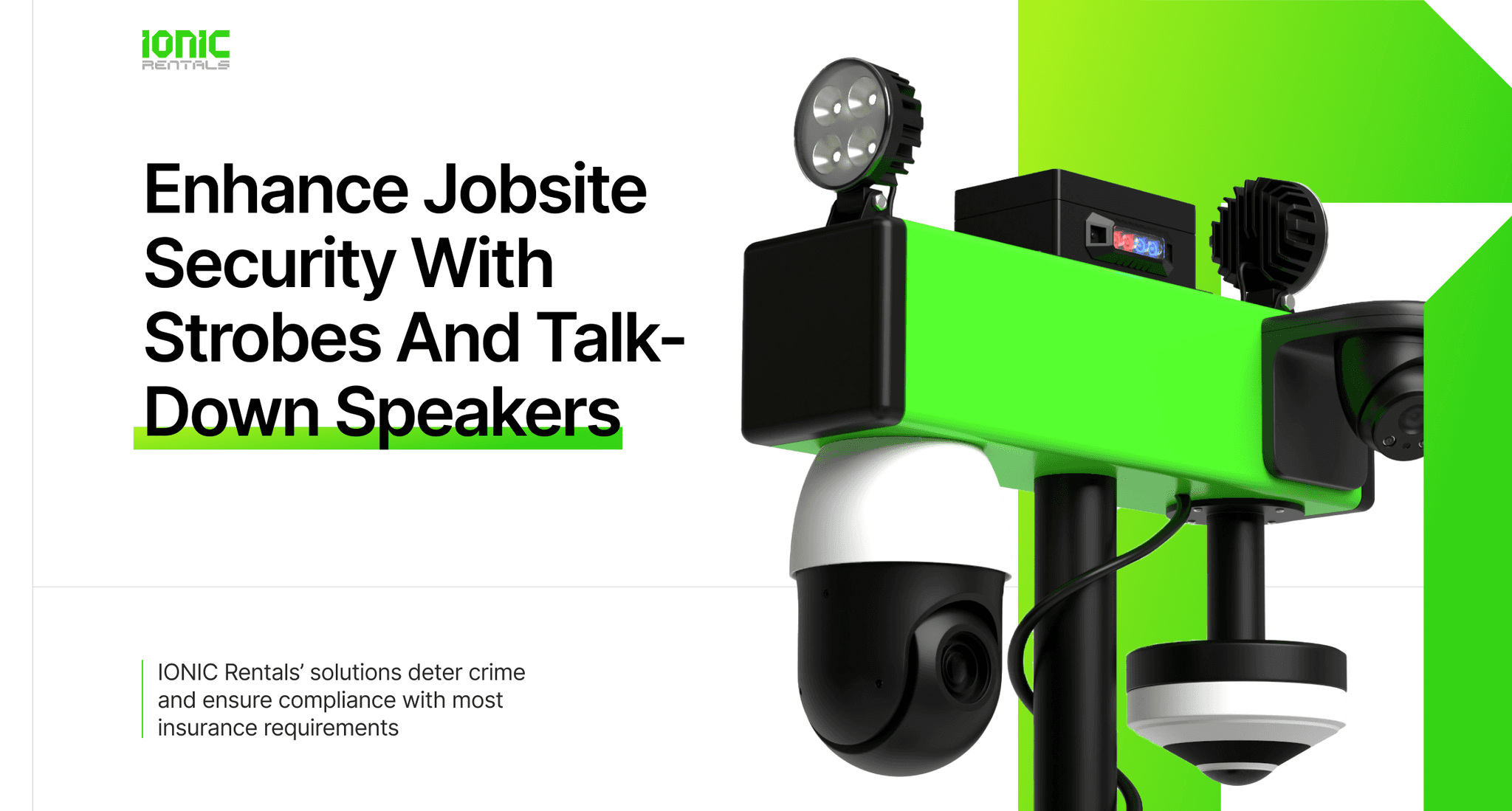
An integrated solar-powered camera tower — strobes, talk-down speaker, and continuous event logging on a single deployed unit — runs the response in stages:
Detection: When a human or vehicle is identified within a monitored zone, strobe lights engage immediately. The site signals that activity has been registered and monitoring is active.
Assessment: A monitoring specialist reviews the event in real time. This step determines whether the activity represents a potential or confirmed threat before any audio intervention is triggered. Assessment before escalation keeps responses proportionate and prevents the false-alarm fatigue that degrades any monitoring program over time.
Live Intervention: When the monitoring specialist determines a verbal response is warranted, the talk-down speaker delivers a live audio warning. Not a pre-recorded message. Not an automated alert. A human voice, specific to what is being observed, delivered in the moment.
Escalation: For events that do not resolve after live intervention, the monitoring specialist contacts law enforcement or designated site personnel. Every event — regardless of outcome — generates a structured incident record within 24 hours, accessible to project stakeholders.
The distinction between a pre-recorded audio alarm and a live talk-down is the difference between a deterrent and an intervention. Pre-recorded alerts are predictable; a practiced actor discounts them quickly. A live voice describing specific, observable behavior introduces an element that automated systems cannot replicate — and that unpredictability is the mechanism.
Why the Live Voice Changes the Calculation
Physical security research consistently distinguishes between signals that indicate monitoring and signals that indicate active human presence. A camera dome indicates monitoring. A strobe indicates that monitoring is active. A live voice describing what is being observed in real time indicates that a human is present, watching, and escalating — in that moment.
The behavioral shift produced by that distinction is well-documented. Someone prepared to act under camera coverage and strobe activation makes a different calculation when they hear their specific location, movement, or action described aloud by a person who is clearly watching in real time. The message being communicated is not "this site is monitored" — it is "you have been identified and the next step is already in motion."
A pre-recorded alert tells an intruder the system is automated. A live voice tells them it is not. That difference changes who stays and who leaves.
This is why the talk-down speaker is not a secondary deterrent or a convenience feature layered onto a camera system. It is the output that completes the deterrence sequence — and in cases where visual deterrence has already been passed, it becomes the primary intervention tool.
The Incident Record the Talk-Down Event Creates
Every talk-down activation generates a timestamped entry in the platform's immutable event log — the same log that captures gate entries, delivery events, and zone-level material check-ins. This matters beyond the deterrence outcome itself.
When a builder's risk underwriter evaluates a claim, or a lender reviews draw documentation, the question is not only whether physical controls were in place — it is whether those controls produced verifiable records. A talk-down event that stopped an intrusion and generated no documentation is a deterrence win and an evidence loss. A talk-down event tied to a structured incident summary, a zone-level timestamp, and a monitoring specialist's assessment is a deterrence win and an audit trail.
The incident record produced within 24 hours of each event is accessible by project stakeholders without requiring them to request footage, contact a monitoring center, or reconstruct a timeline after the fact. It exists as a continuous, structured record from the moment the system goes active on site.
What This Means for Builder's Risk Coverage
Builder's risk underwriters assess physical security controls as part of both coverage qualification and post-loss claim evaluation. The presence of active deterrence hardware — cameras, strobes, and live talk-down capability — establishes that the site operator implemented documented, proportionate physical controls.
What distinguishes an integrated camera-strobe-talk-down system from a standalone deterrence installation is exactly this documentation chain. Physical controls that produce audit trails satisfy more of the underwriter's evaluation criteria than physical controls that produce footage alone. When a loss event does occur — whether at the perimeter or within a documented zone — the incident record is already structured. It does not need to be assembled; it was being generated continuously.
The Output That Completes the Sequence
Strobes mark the zone. Talk-down marks the intervention. The incident record marks what happened, when, and what the response was.
A single integrated unit — solar-powered, with three days of operational autonomy — delivers all three outputs without requiring separate devices, separate monitoring arrangements, or gaps between detection and response.
When the perimeter holds, that is the expected outcome. When it is tested, the talk-down speaker is the output that makes the difference between a deterred actor and a completed loss event. That is what it is built to do — and the structured record it generates is what makes that outcome defensible after the fact.
Contact us to learn more about how active deterrence hardware integrates with material accountability documentation on your next project. #JobsiteSecurity #ActiveDeterrence #LossPrevention #BuildersRisk #ConstructionSafety #TalkDown #JobsiteManagement